Easy Picasso Paintings to Draw
Pablo Picasso was a Spanish painter, sculptor, and printmaker. He is one of the most recognized artists of the 20th century.
He has made an indelible influence on popular culture and modernistic art.
Picasso'due south artistic way changed throughout his career, but he always maintained a unique insight into the human condition that would never be equaled past any other painter.
Pablo Picasso's fine art style was characterized by large, colorful surfaces and distorted proportions in his paintings. His work has been considered to exist revolutionary because his diverse techniques challenged traditional concepts of what paintings should look like.
His style is known for the use of bold, contoured lines. He often merged representational and abstract, with one on summit of the other.
Picasso was a pioneer of the Cubism movement that explored the significance of geometric shapes in the context of painting. This technique has been, and still is used by many artists today who want to stress functionality over dazzler.
Pablo Picasso's Virtually Famous Paintings
1. Guernica
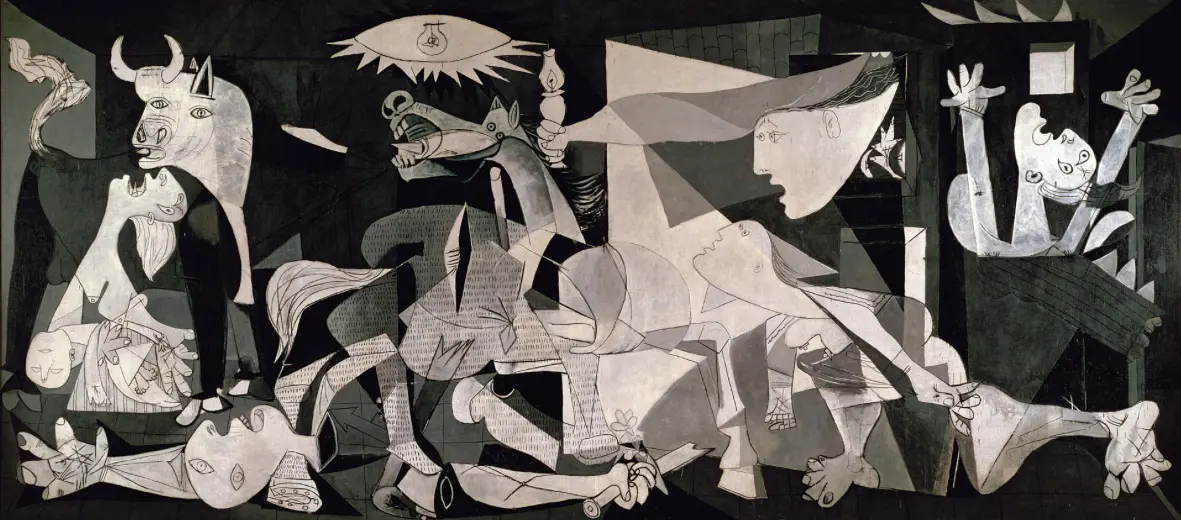
Picasso was deeply afflicted past the horrors of the Spanish Ceremonious War, which had begun on 17 July 1936 when General Francisco Franco led a military insurrection against the Spanish Democracy.
Vii months later, Franco's troops were in total command of the country. Later visiting Barcelona in October 1936 and witnessing widespread destruction from heavy fighting, Picasso told his friend Joan Miró that he wanted to exercise something to evidence his anger.
He later wrote: "I'm going to pigment something unbelievably huge… I'll do it with all my rage." He began making sketches for the painting on two December 1936.
Guernica has been described as the creative person'southward about powerful cosmos, and one of his few works on a truly epic scale.
The painting was created in response to the bombing of Guernica, a Basque Country town in northern Spain, by German planes commanded by General Franco during the Spanish Civil State of war. It depicts the tragedy and suffering of state of war with startling power.
The painting was completed by Picasso in 1937 and it has been considered to be one of his most famous works. It depicts the horrors of war, including violence and death.
The painting does not depict any specific boxing or event, but rather all of the events that transpired during war.
two. Les Demoiselles d'Avignon
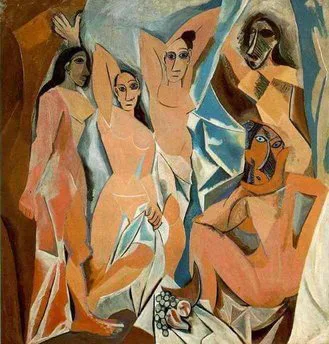
" Les Demoiselles d'Avignon" is considered to be the first Cubist piece of work of art. Information technology is a painting created past Pablo Picasso in 1907. The painting was created during the height of his determinative Cubism menstruation and is one of the most of import pieces in the history of modern art.
Picasso arrived in Paris at a time when in that location were many artists creating new, innovative styles of artwork. For Picasso, this meant that he was non still pigeonholed into one mode and could explore many avenues without much worry from critics or other artists.
This freedom gave him room to explore his inventiveness and experiment with different techniques and methods without feeling pressured to conform to what others were doing at the fourth dimension.
The painting was created out of a mixture of styles that Picasso had been experimenting with during that period. It was an important moment in his career as it helped him break through to brainchild and to mod art.
This painting is as well meaning because when it was debuted in public, it shocked many people and caused a lot of negative reactions because they were not used to such paintings at the time.
three. The Weeping Adult female

Pablo Picasso was well-known for his bizarre interpretations of different characters he painted. Later in his life, he started to pigment in more vibrant hues in order to convey the emotional importance of the subject.
The Weeping Woman is an oil on sail work past Pablo Picasso that was completed in 1937 in France. Dora Maar, Picasso's mistress and muse, is shown in the movie.
Picasso's signature profile view of the woman'south confront appears in this piece, simply other small details hint to a college caste of perspective for the viewer to perceive.
The piece is primarily concerned with the woman's face, which is shown in a diverseness of ambivalent colors and geometric forms. Picasso's utilize of subtle blue hues on her face below the optics, which seems to suggest that her face is covered in tears, emphasizes her high degree of emotional sorrow even more than.
"Weeping Adult female" shows a distraught female person weeping and belongings a handkerchief to her confront to collect her profuse tears.
This universal picture of suffering is painted in the flattened manner of Picasso'south early analytical Cubism, which is distinguished by the utilize of athwart and overlapping pieces of the discipline'south face up, as if painted from many perspectives at the same time.
4. The Former Guitarist
Picasso spent nigh of his life in extreme poverty, and it is claimed that during this menstruation he developed a strong sympathy with the world'southward impoverished and oppressed.
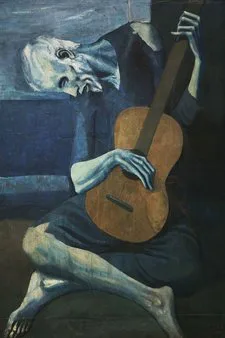
The Sometime Guitarist was created in 1903, during a flow when Picasso was believed to be most bankrupt while living in Barcelona.
This time has been dubbed his 'Bluish' phase, when he painted nearly every canvass in a drab monochromatic palette of bluish, a hue that matched the kind of field of study matter that he would address.
Picasso created this piece soon after his close friend Casagemas committed suicide equally a upshot of a lengthy boxing with mental illness and despair.
The artist dedicated this piece, equally well as others during this fourth dimension flow, to concentrating on people who are frequently oppressed and burdened by the concerns and problems that so often swallow humanity.
Because the whole work is done in a deep blue color, the painting conveys a stiff feeling of desolation to the spectator.
The man in the film is holding a guitar and seems to be playing a sorrowful song, his confront set with agony and despair.
Picasso's excellent use of the color blue, art critics and historians have observed, correctly imposes the feeling of melancholy that then many people experience in this slice.
The guitar is a pause in the monochromatic blue's subdued nearly flat, 2-dimensional shapes, while the musician seems slumped downward and sad.
Subsequent X-rays of the artwork showed the presence of a ghostly figure (a lady) that Picasso had begun to paint just then changed his heed and chose to pigment over her.
5. Self-Portrait 1901

Picasso was quite young in this famous self-portrait and was just 20 at the fourth dimension, nonetheless he looks much older in this pic. His face looks drawn and haggard every bit a result of the hard wintertime in Paris living a very downtrodden life.
He had merely recently arrived in Paris and had nevertheless to constitute any meaningful friendships when he created this slice soon later on the suicide of his friend Carlos Casagemas.
The death hit him hard and had a serious effect on his mental wellness.
This cocky-portrait is not Picasso's commencement, merely it is one of the primeval works of the Blue Period.
6. Girl earlier a Mirror

Pablo Picasso produced Girl earlier a Mirror in 1932 as an oil on canvas painting. The motion-picture show depicts Picasso's mistress and muse, Marie-Thérèse Walter, standing in front of a mirror, gazing at her reflection.
During the 1930s, Picasso painted Marie-Thérèse many times. His pictures of her from 1932 were the first public exhibition of their clandestine romance during his matrimony to Olga Khokhlova.
Picasso's creative career was shaped past the year 1932. He had reached the age of 50 at this bespeak in his life and had established himself as a pregnant artist.
Picasso was the curator of a retrospective prove of his work at Galerie Georges Petit in 1932, which was an uncommon occurrence for an artist, and even more unexpectedly, Picasso seized charge of the curating.
Daughter before a Mirror is a photograph of a lady gazing in a mirror, revealing a darker reflection of herself. The woman's face has been split up into ii parts, i of which is painted in a peaceful, lilac color, and the other in a vibrant, yellow hue.
The reflection depicts the subject in a different light, making her seem older and with a sunken face up, perchance as a symbol of her expiry.
7. La Vie

La Vie (The Life) is an oil on sail work that was completed in May 1903 in Barcelona.
It is generally considered every bit the peak of Picasso's Blueish Period's. Yet, at the time he was a 22-year-former unknown artist who had nonetheless to make his impact on the world of art.
The interpretation of the mysterious composition has sparked considerable debate. I thing is articulate is that it is Picasso'south homage to his shut friend Carlos Casagemas who had committed suicide.
Picasso'southward business with life and death is completely represented in its somber mood.
eight. Ma Jolie

Picasso's 1911 painting, Ma Jolie, openly portrays his girlfriend, Marcelle Humbert.
Picasso claimed Ma Jolie, which means "my beautiful one," was a reference to a famous music-hall song from the time, but the existent significant was kept subconscious, known merely to those close to his circle of acquaintances.
As the principal image fades into the depths of abstract surfaces and tiny details, the irregular forms and night, brackish hues seem to communicate a deeper bulletin.
Marcelle Humbert's effigy is synthetic in a haphazard manner utilizing Analytic Cubism'due south characteristic irresolute planes.
The half-dozen strings in the middle of the image are a reference to the guitar, while the triangle on the right seems to stand for the woman's elbow.
9. 3 Musicians

3 Musicians is the championship of 2 collage and oil works by Picasso . Both were finished in 1921 in Fontainebleau, France, near Paris, and are splendid examples of the Constructed Cubist style.
Each artwork depicts a Harlequin, a Pierrot, and a monk, who are said to be Picasso, Guillaume Apollinaire, and Max Jacob, respectively.
The Harlequin playing a guitar in the middle is a recurrent stand up-in for Picasso himself throughout his work. Pierrot and Harlequin are standard figures from the aboriginal Italian one-act theater known equally Commedia dell'Arte, which is a recurring discipline throughout Picasso's piece of work.
Three Musicians seems to be a collage created from cut out pieces of colorful paper, despite the fact that it is an oil painting. The forms are reduced to athwart patterns that interlock like jigsaw puzzles.
Three Musicians is part of a major modify in Picasso'due south piece of work that happened later 1914. Picasso created but a few collages after 1914. Instead, he used Cubist techniques in the conventional medium of oil on canvas, allowing him to produce considerably bigger and more colorful works.
This new technique had a major advantage: oil paintings could be sold at much greater prices than collages.
10. Portrait of Gertrude Stein

Portrait of Gertrude Stein is an oil on canvas portrait of the American writer and art collector Gertrude Stein. Picasso began working on the painting in 1905, simply information technology was not completed until the following twelvemonth.
It is regarded as ane of Picasso's most meaning paintings from his Rose Menstruation.
The motion picture exemplifies the geometric distortions and formal experiments that would come to ascertain his work afterward the advent of Cubism.
Picasso's artwork defied conventional portraiture conventions by portraying the field of study as a huge, hulking figure staring blankly across the movie rather than at the spectator. Her effigy is a circular bulk, and she leans frontward, her artillery weightily resting on her knees.
This stylistic shift proved to be of enormous historical significance since it indicated the path Picasso would take footstep past step until the creation of cubism.
pritchardsibacted.blogspot.com
Source: https://www.artst.org/picasso-paintings/
0 Response to "Easy Picasso Paintings to Draw"
Post a Comment